
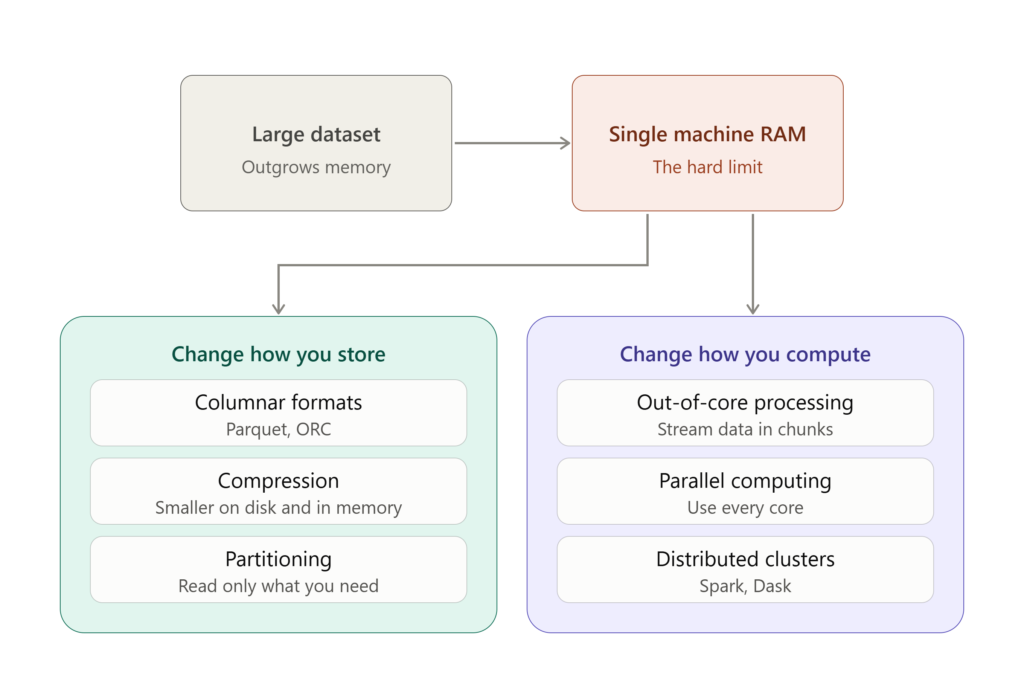
The core challenge of working with large datasets usually isn’t algorithmic complexity it’s the hard limit of available hardware. When data outgrows your RAM, or single-machine processing times become unacceptable, traditional workflows hit a wall. The solutions boil down to two main ideas: change how you store data and change how you compute on it.
From “Load Everything” to “Divide and Conquer”
Pandas is the default starting point for data analysis, but it has a fundamental flaw: it needs to load the entire dataset into memory before doing anything. When you exceed available RAM, the system starts swapping to disk, performance collapses, and you eventually get a MemoryError.
Tools like Dask and esProc SPL offer different ways out. Dask uses lazy evaluation transformations aren’t executed when you define them, but only when results are actually needed, processing data in chunks and releasing memory as it goes. esProc SPL takes a more direct approach with cursor mechanisms and file segmentation, letting you stream data block by block or physically split large files into segments that are processed independently and then merged.
The shared logic here is simple: don’t let the size of your data dictate your tooling let your tooling adapt to the size of your data.
Columnar Storage: The Most Underrated Speed Lever
If you could only do one thing to improve large-dataset processing efficiency, switching from CSV to Parquet might give you the best return on effort.
CSV is plain text. Reading it means parsing line by line, inferring types, and paying for every byte slow and error-prone. Parquet is columnar binary storage, which delivers two immediate wins: queries only read the columns they need instead of scanning the whole file, and file sizes are typically a fraction of the original CSV. In one real-world case involving drone telemetry data, migrating from CSV to Parquet was described as producing an “exponential” improvement in read speed.
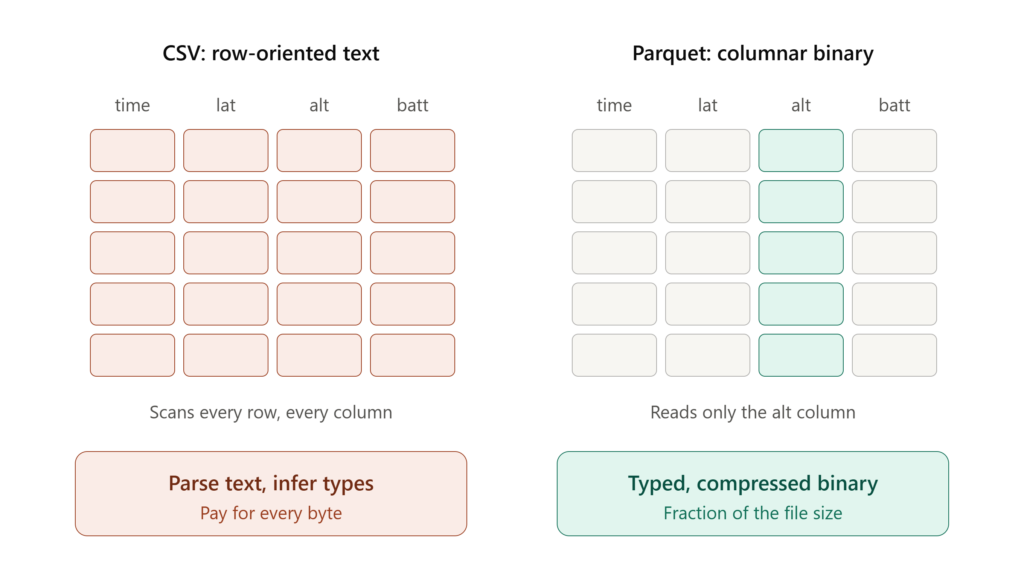
There are trade-offs. Parquet is binary, so you can’t eyeball it in a text editor, and quick manual sanity checks become more cumbersome. But for large datasets, that’s usually a price worth paying.
Distributed Computing: What Spark Actually Solves
When the problem shifts from “doesn’t fit on one machine” to “runs too slowly on one machine,” distributed frameworks become necessary. Apache Spark is the reference point here its core strength is splitting computation across multiple machines for parallel execution, while in-memory processing cuts down on disk I/O.
A case study from Statistics Netherlands (CBS) is instructive. Working with traffic sensor data, policy statistics, and natural observation data, they adopted Spark and found it particularly well-suited for scenarios requiring combining different types of data and running complex computations. A key takeaway: Spark didn’t just speed up existing statistical pipelines it made “drawing conclusions from data in real time” feasible.
At larger production scales, Spark paired with a table format like Apache Iceberg can handle petabyte-level data. In one Vodafone Idea case, rebuilding their data platform on Spark and Iceberg cut some query times by 80%, with individual queries dropping from over 70 hours. Iceberg’s ACID transactions and schema evolution keep large-scale pipelines from spiraling out of control when things change.
Scaling Feature Engineering
For machine learning workflows, large-dataset pain concentrates in feature engineering. High dimensionality, noise, and missing values all get worse as data volume grows.
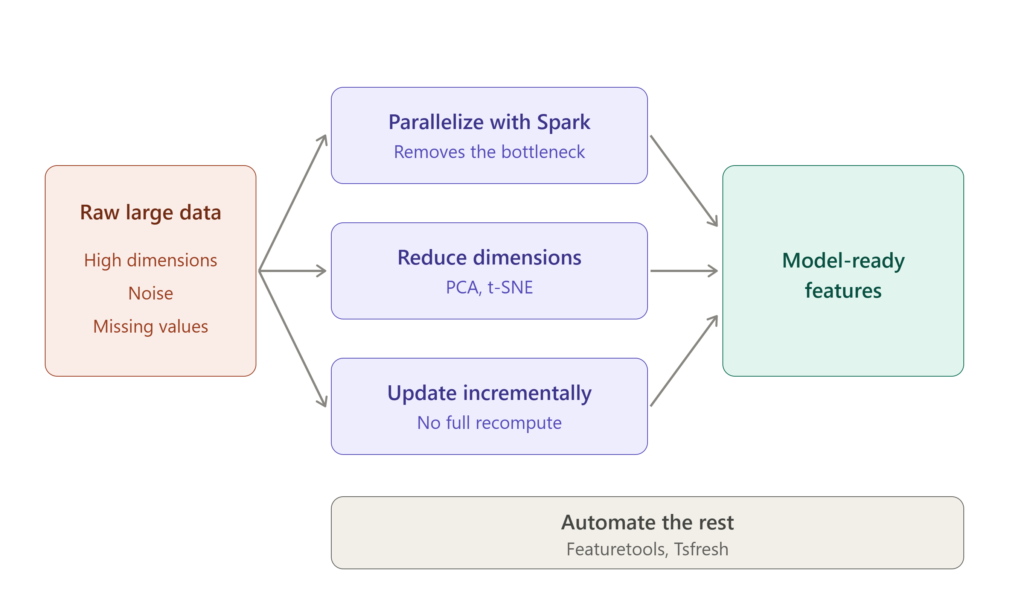
A few proven strategies: use frameworks like Spark to parallelize feature computation so feature generation stops being the bottleneck; apply dimensionality reduction (PCA, t-SNE) to compress feature space while keeping the most informative components; and for continuously arriving data, use incremental algorithms instead of recomputing from scratch every time. Automation tools like Featuretools and Tsfresh can handle part of the feature generation and selection work, reducing manual coding overhead.
A Practical Decision Framework
When choosing tools, don’t chase “newest” or “most powerful.” A pragmatic chain of reasoning works better: if the data fits in memory, use Pandas simple and direct. If it doesn’t fit but a single machine can still handle it, Dask or esProc SPL’s cursor/segmentation approach is a low-friction upgrade. If you need cross-machine parallelism or integration with a broader data ecosystem, Spark plus columnar storage is a battle-tested combination.
The real key isn’t the tool itself it’s whether you’re willing to change your storage format and computation paradigm before data volume hits the breaking point, rather than after.