
Randomisation in Experiments: Why It Matters More Than You Think
We’ve all been there. You have a brilliant idea for a new feature, a marketing campaign, or a health intervention. You’re convinced it’s going to change everything. So, you roll it out, sit back, and watch the results roll in. The numbers go up. Success, right?
Not so fast.
In the world of data and decision-making, we often confuse correlation with causation. We think that because B happened after A, A must have caused B. But what if the economy shifted? What if it was a seasonal trend? What if the loudest, most enthusiastic users were the ones who adopted the change first?
This is where the magic happens and the magic is called Randomisation.
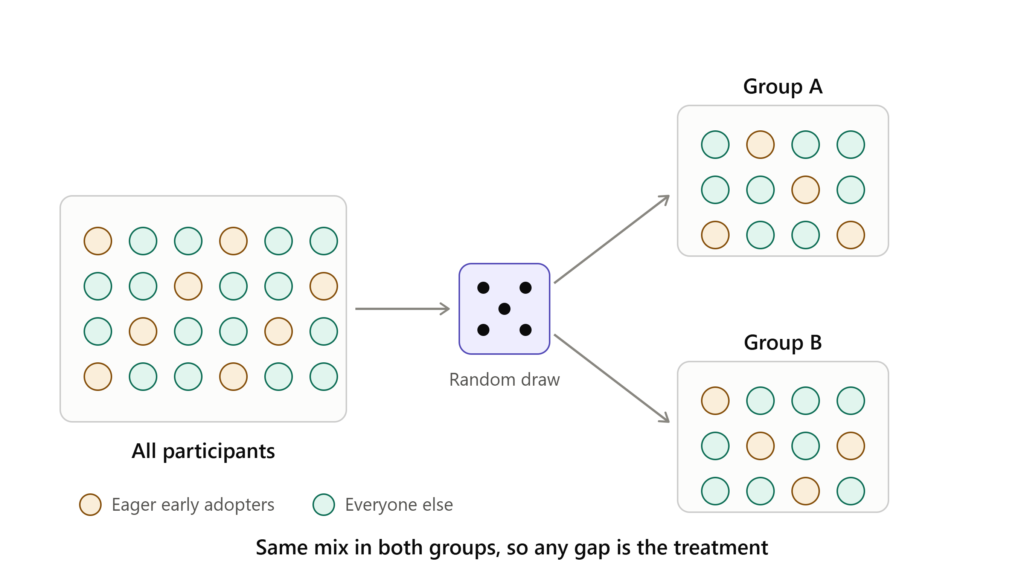
If you think randomisation is just a boring statistical technicality, think again. It is the invisible shield that protects you from fooling yourself. Here is why it matters more than you think.
The “Counterfactual” Problem
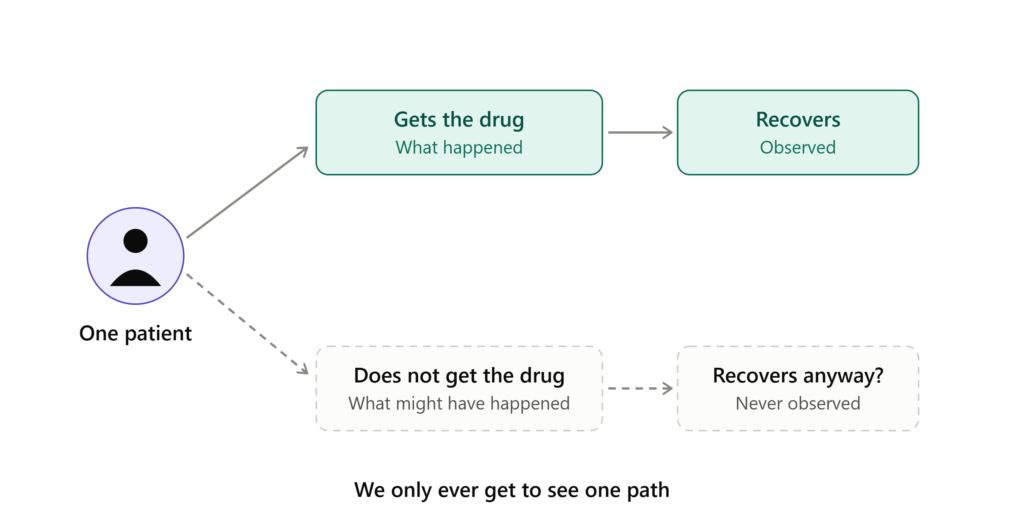
The fundamental problem of causal inference is that we can never observe the counterfactual. If I give a patient a new drug and they recover, I don’t know what would have happened if I hadn’t given them the drug. Maybe they would have recovered anyway.
In an experiment, we want to compare the Treatment Group (who get the intervention) with the Control Group (who don’t). But if we let people choose their own groups, we introduce Selection Bias.
Imagine testing a new study program. If you let students volunteer, who signs up? The highly motivated students. If they get better grades, is it because of the program, or because they were already motivated? You’ll never know.
Randomisation solves this. By flipping a coin to assign people to groups, you ensure that, on average, the groups are identical in every way—except for the intervention. You balance out the motivation, the income, the age, and even the variables you didn’t know existed. It is the only way to create a true “apples-to-apples” comparison.
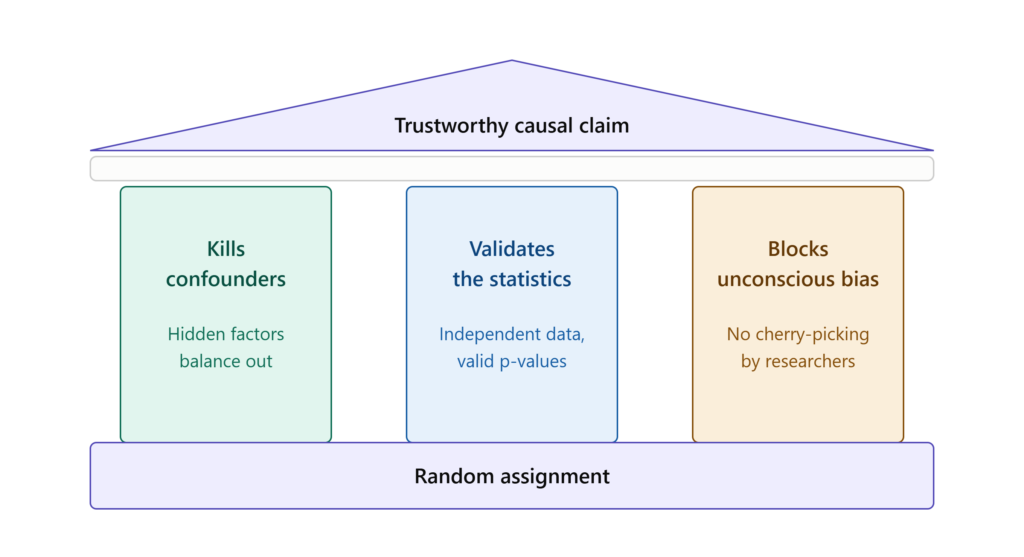
The Three Pillars of Why It Works
1. It Kills Confounding Variables
A confounding variable is a hidden third factor that influences both the cause and the effect. Let’s say you notice that people who carry lighters get lung cancer at higher rates. Does carrying a lighter cause cancer? No. The confounder is smoking.
Randomisation distributes these confounders evenly. Since assignment is random, the smoker is just as likely to end up in the control group as the treatment group. The hidden variables cancel each other out, leaving you with a clean signal.
2. It Validates the Statistics
Most statistical tests (like p-values and confidence intervals) rely on a specific assumption: that the data points are independent and identically distributed. Randomisation is the mechanism that guarantees this.
Without random assignment, your statistical tests are essentially built on sand. You can run the math, but the results won’t be statistically valid because the underlying assumptions are violated.
3. It Protects Against Unconscious Bias
Even the most well-intentioned researcher can be biased. If a doctor gets to choose who gets the new experimental drug, they might subconsciously give it to the sickest patients (hoping to help) or the healthiest patients (hoping for a success story). Randomisation takes the human element—and human bias—out of the equation.
The “A/B Test” Trap
In the digital world, we love A/B testing. But not all A/B tests are created equal.
If you test a new website layout by showing it to users in New York and comparing them to users in London, you aren’t running an experiment; you’re running an observational study with geography as a confounder.
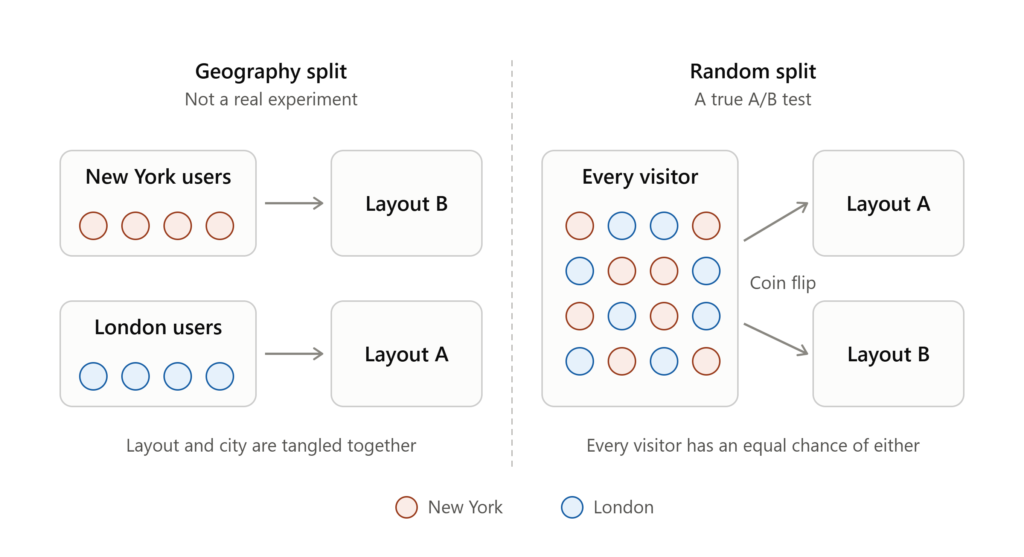
True randomisation means every single user who visits your site has an equal probability of seeing Version A or Version B. This is the only way to ensure that the difference in conversion rates is actually due to the layout, and not the time zone, the weather, or the device they are using.
The Ethical Dilemma (and Why It’s Actually Okay)
Critics often ask, “Isn’t it unethical to withhold treatment from the control group?”
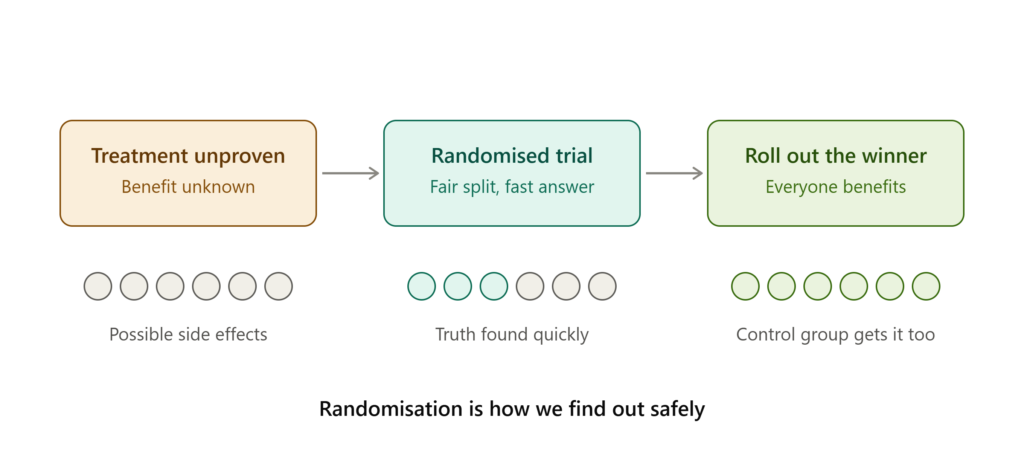
This is a valid concern, but in many cases, randomisation is the most ethical approach. If we don’t know if a treatment works, giving it to everyone exposes them to potential side effects for no proven benefit. Randomisation allows us to find out the truth quickly and safely. Furthermore, once the experiment is over and the results are clear, you can roll out the winning intervention to everyone.
The Bottom Line
Randomisation is not just a box to check on a methodology list. It is the very foundation of credible knowledge.
Whether you are a data scientist optimizing a funnel, a product manager testing a feature, or a policymaker evaluating a social program, your goal is to separate signal from noise. Randomisation is the filter that does the heavy lifting.
So, the next time you see a “successful” test, ask the golden question: “How were the groups assigned?”
If the answer isn’t “randomly,” proceed with caution. You might just be looking at a coincidence dressed up in a lab coat.