
Confounding Variables: The Hidden Factors That Ruin Your Results
You’ve done everything right. You designed a clean experiment, gathered a massive dataset, and ran the analysis. The results are statistically significant. You pop the champagne, ready to present your findings to the world.
But wait.
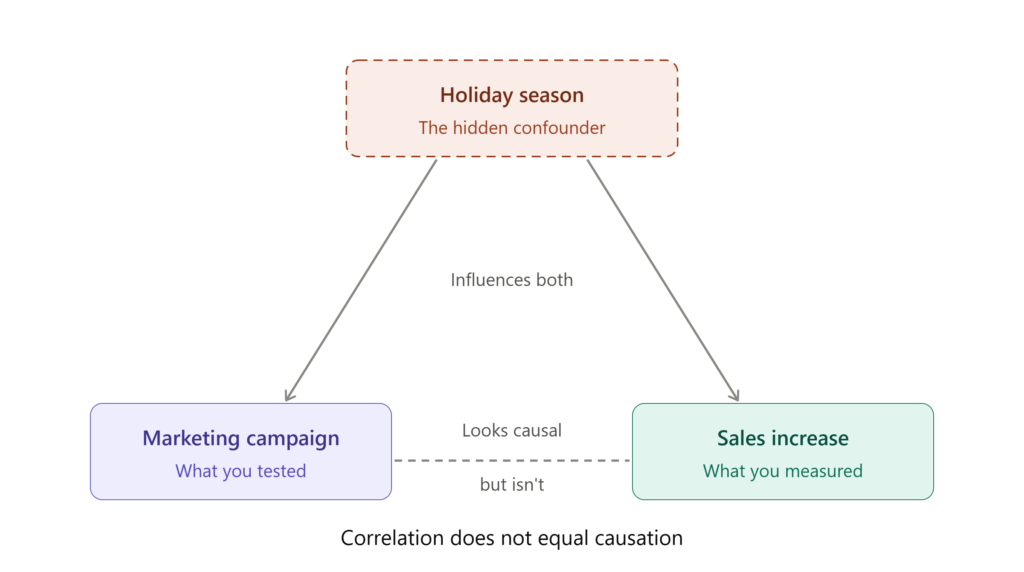
What if the reason your sales went up wasn’t the new marketing campaign, but the fact that you launched it during the holiday season? What if the reason a new drug seemed to work wasn’t the drug itself, but the fact that the patients taking it were also given a healthier diet?
In the world of data and research, there is a silent killer that lurks in the shadows of every study. It is the reason correlation does not equal causation. It is the Confounding Variable.
Whether you are a data scientist, a marketer, a student, or a business leader, understanding confounding variables is the difference between making a brilliant decision and walking blindly into a trap.
What is a Confounding Variable?
In simple terms, a confounding variable (or “confounder”) is an outside influence that changes the effect of a dependent and independent variable. It is a third variable that muddies the waters, creating a spurious relationship between two other variables.
Imagine you are trying to prove that Ice Cream Sales (A) cause Drowning Incidents (B) . You look at the data and see a strong correlation: as ice cream sales go up, drownings go up.
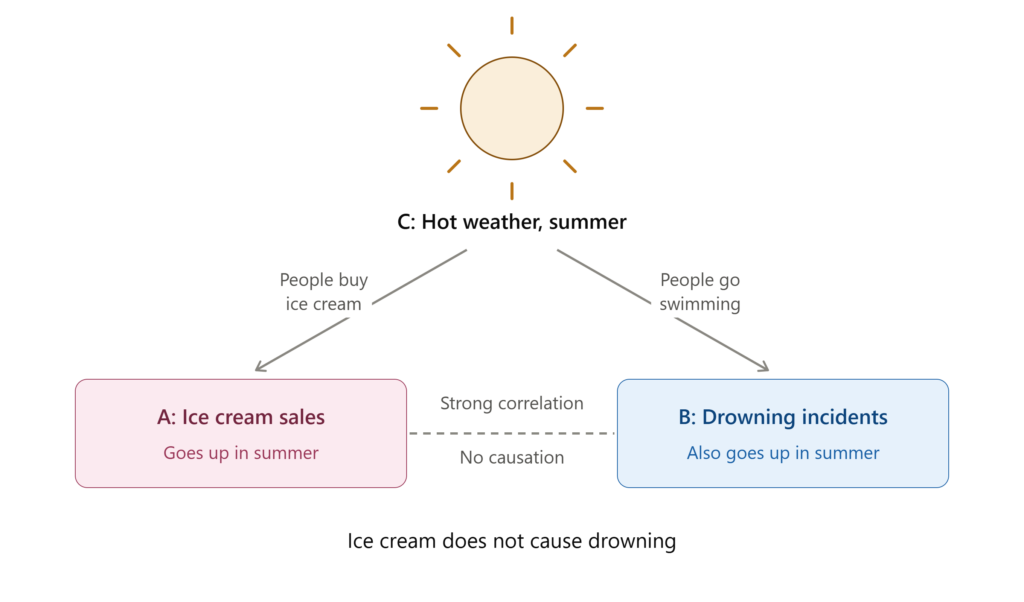
Does ice cream cause drowning? Of course not. The Confounding Variable (C) here is Temperature/Summer.
- Hot weather causes people to buy ice cream.
- Hot weather causes people to go swimming (and unfortunately, drown).
If you don’t account for the temperature, you might draw the absurd conclusion that ice cream is dangerous.
Why Do Confounders Matter?
Confounders are dangerous because they create bias. They trick us into seeing a cause-and-effect relationship where none exists, or they hide a real relationship that is actually there.
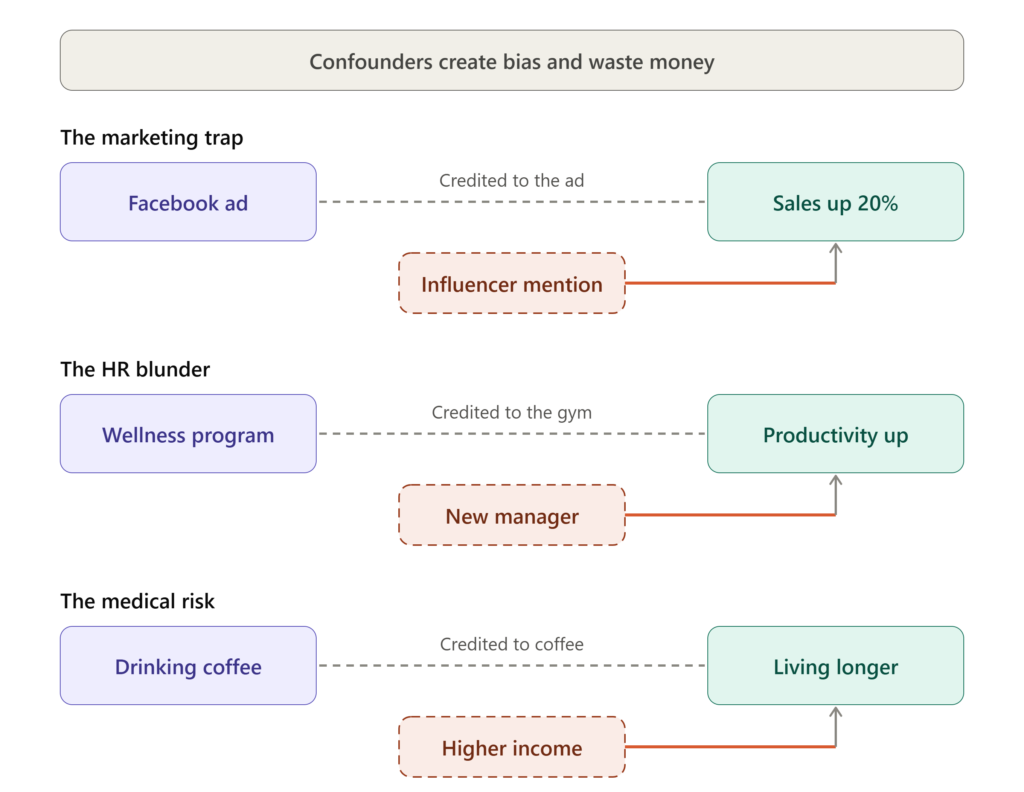
In the business world, this translates to wasted money and failed strategies. Consider these scenarios:
- The Marketing Trap: You run a Facebook ad campaign and see a 20% spike in sales. You credit the ad. However, the confounding variable might be that a famous influencer happened to mention your brand on the same day. If you double your ad spend based on flawed data, you might not see the same return next time.
- The HR Blunder: A company introduces a “wellness program” and sees productivity rise. The confounder? The company also hired a new, highly motivated manager at the same time. The productivity boost likely came from the manager, not the free gym memberships.
- The Medical Risk: A study shows that people who drink coffee live longer. The confounder? People who drink coffee might generally have higher incomes, which correlates with better healthcare and nutrition.
How to Spot a Confounder
Identifying confounders requires critical thinking and a healthy dose of skepticism. Here is how to hunt them down:
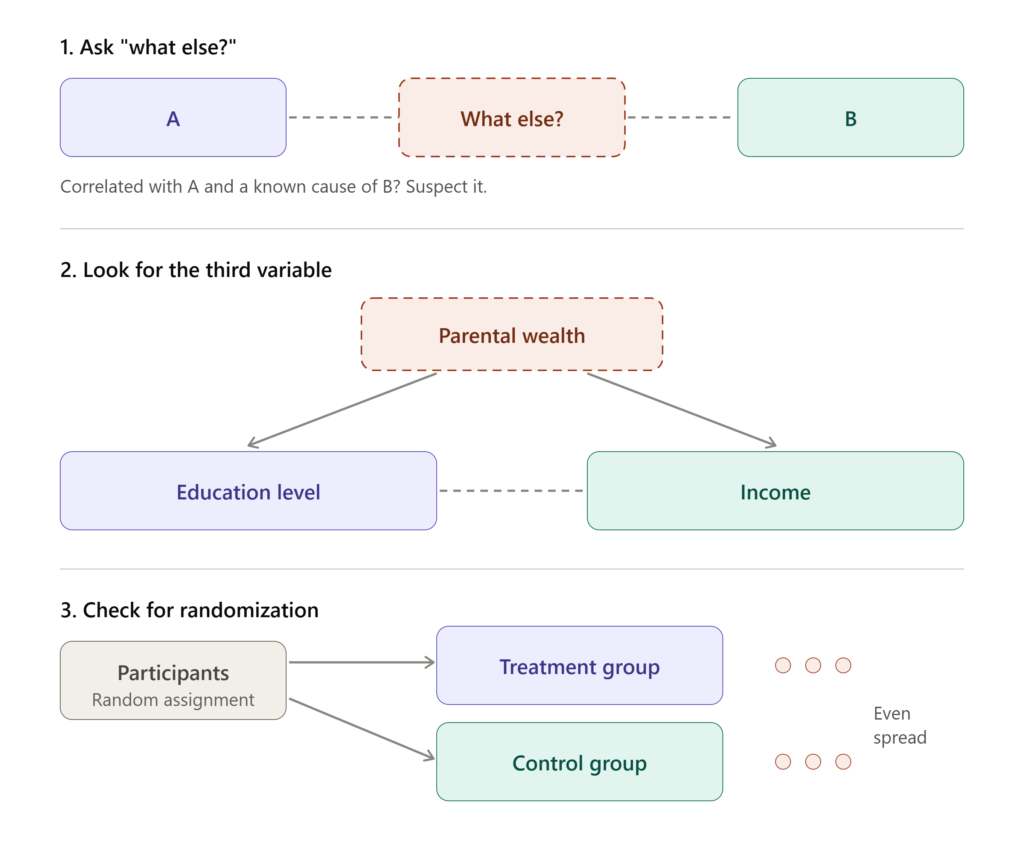
1. Ask “What Else?”
Whenever you see a relationship between A and B, ask yourself: What else could be affecting B? If there is a variable that is correlated with A and is a known cause of B, you have found a potential confounder.
2. Look for the “Third Variable”
In observational studies, you aren’t controlling the environment. Look for the “hidden” third variable. For example, if a study links education levels to income, the confounder might be “parental wealth”—wealthy parents often provide both better education and better career networks.
3. Check for Randomization
In a Randomized Controlled Trial (RCT), participants are randomly assigned to groups. This is the gold standard because randomization distributes confounding variables evenly across groups, neutralizing their effect. If you are looking at observational data (where randomization didn’t happen), be suspicious.
How to Control for Confounders
If you suspect a confounder is ruining your results, you can take steps to isolate it:
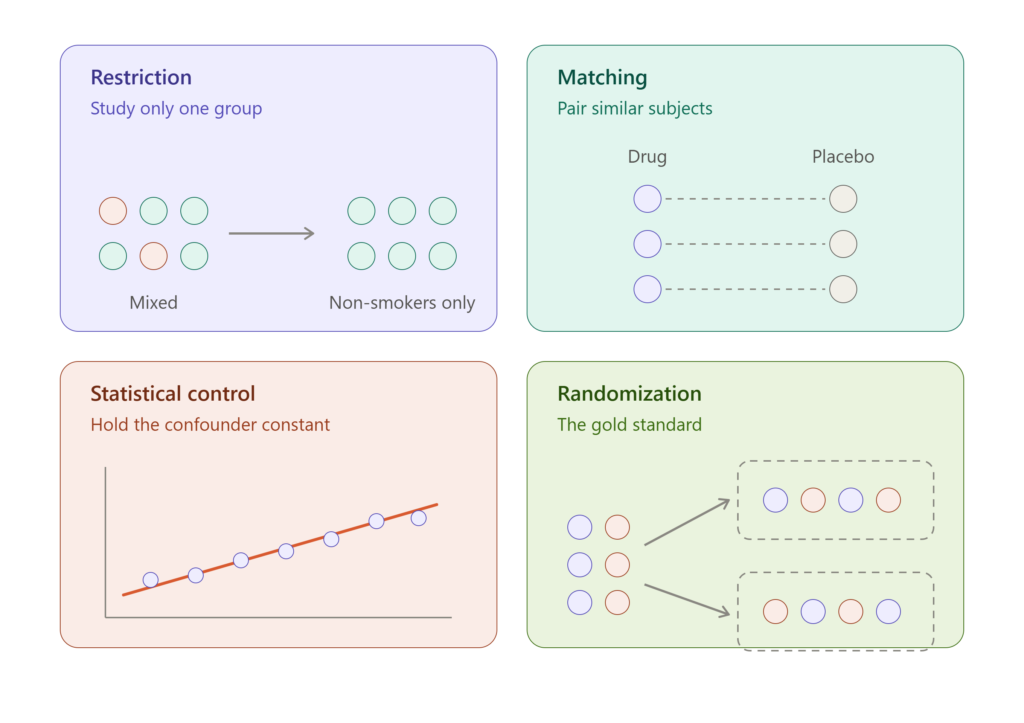
- Restriction: Limit your study to only one group. (e.g., If studying the effect of a drug, only test it on non-smokers to eliminate smoking as a confounder).
- Matching: Pair subjects with similar characteristics. (e.g., Match a 30-year-old male taking the drug with a 30-year-old male taking a placebo).
- Statistical Control: Use statistical methods like regression analysis to “hold constant” the confounding variable while measuring the others.
- Randomization: The best method. Randomly assign people to different groups to ensure confounders are spread out.
The Takeaway: Correlation is Not Causation
The next time you see a headline screaming that “Chocolate Cures Baldness” or “People Who Walk Backwards Live Longer,” look for the confounder.
As a content writer, I see this all the time in content marketing. We attribute a spike in traffic to a new SEO strategy, ignoring the fact that a major news site linked to us that same week.
Don’t let hidden factors ruin your results. By identifying confounding variables, you move from merely observing the world to truly understanding it. And in a world drowning in data, understanding is the only currency that matters.