
Instrumental Variables Explained: Solving Endogeneity in Research
In the world of data analysis, we love to draw lines between cause and effect. We want to know: Does education increase income? Does a new drug lower blood pressure? Does a marketing campaign drive sales?
However, the real world is messy. Unlike a controlled laboratory experiment where you can hold everything else constant, observational data is full of hidden traps. One of the most persistent and dangerous traps is endogeneity.
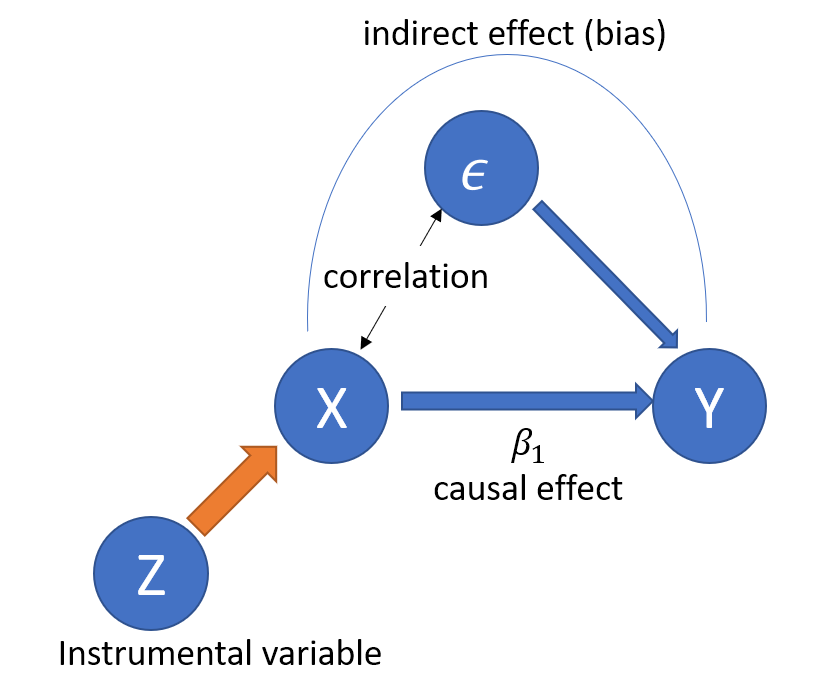
If you’ve ever been told that “correlation does not imply causation,” you’ve brushed up against the endogeneity problem. But for researchers and data scientists, acknowledging the problem isn’t enough—we need to solve it.
Enter the Instrumental Variable (IV) . It is one of the most powerful tools in the econometrician’s toolkit for untangling causal relationships when controlled experiments are impossible.
The Problem: What is Endogeneity?
Before we solve the puzzle, we must understand the pieces. Endogeneity occurs when an explanatory variable (independent variable) is correlated with the error term in a regression model. In simpler terms, it means there is a “hidden third factor” influencing both your cause and your effect, or causality is running in both directions.
There are three main culprits behind endogeneity:
- Omitted Variable Bias: You leave out a variable that affects both X and Y. (e.g., studying the effect of education on income, but ignoring “natural ability,” which affects both).
- Simultaneity (Reverse Causality): X causes Y, but Y also causes X. (e.g., Does higher police presence reduce crime, or does higher crime lead to more police presence?).
- Measurement Error: You measured X imperfectly.
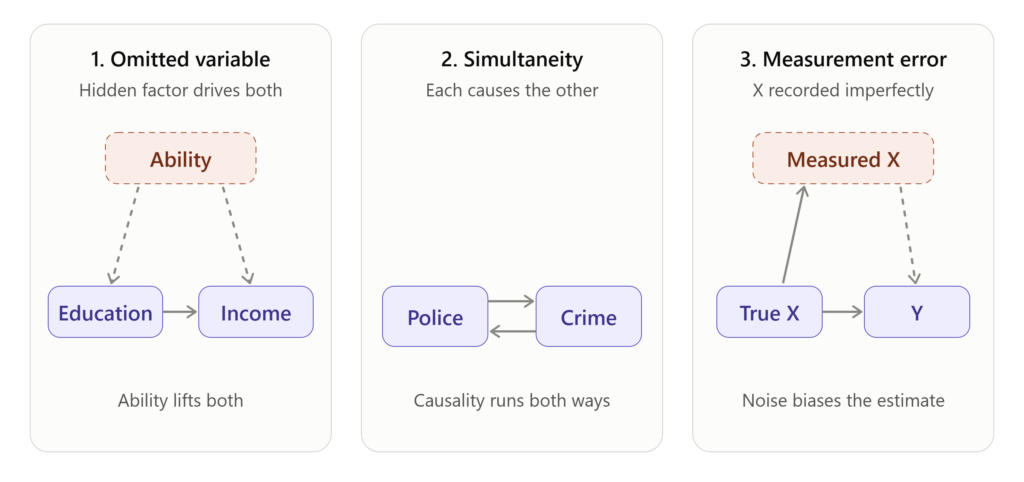
When endogeneity is present, standard regression (like OLS) fails. It produces biased and inconsistent estimates. You might find a relationship that doesn’t actually exist, or miss one that does.
The Solution: What is an Instrumental Variable?
An Instrumental Variable is a third variable (let’s call it Z) that allows us to isolate the causal effect of X on Y.
Think of it as a “clean” source of variation. Instead of using the messy, contaminated variation in X (which is tangled with the error term), we use only the part of X that is influenced by Z.
However, not just any variable can be an instrument. To qualify as a valid Instrumental Variable, Z must satisfy two strict conditions:
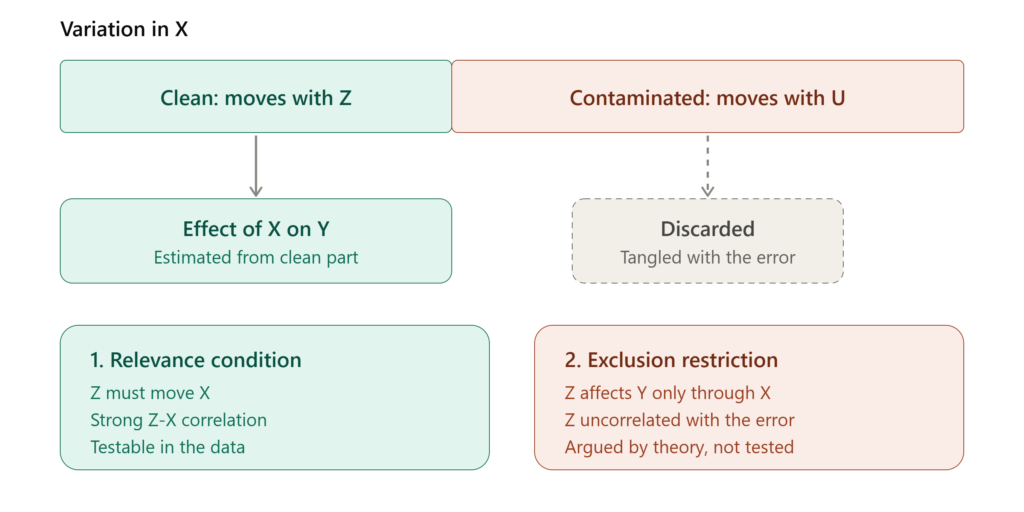
1. The Relevance Condition
The instrument must affect the endogenous explanatory variable (X). There must be a strong correlation between Z and X. If Z doesn’t move X, it’s useless.
2. The Exclusion Restriction (Exogeneity)
The instrument must not directly affect the outcome variable (Y), except through its effect on X. It also must not be correlated with the error term (the unobserved factors).
Note: This second condition is often untestable and must be argued theoretically.
A Classic Example: Education and Earnings
To make this concrete, let’s look at the “gold standard” example used in economics: estimating the return on education.
The Question: Does going to college increase your future salary?
The Problem: Omitted variable bias. People who go to college might be smarter, more motivated, or have richer parents. These factors also increase income. We can’t just compare college grads to non-grads because the groups are fundamentally different.
The Instrument: How do we isolate the effect of education? In the 1990s, economists Joshua Angrist and Alan Krueger used Quarter of Birth as an instrument.
- Relevance: Due to compulsory schooling laws, people born in different quarters of the year start school at different ages and can legally drop out at different points. This creates variation in how much schooling people get.
- Exclusion: Being born in, say, January versus December doesn’t directly affect your adult wages (except through the amount of schooling you received).
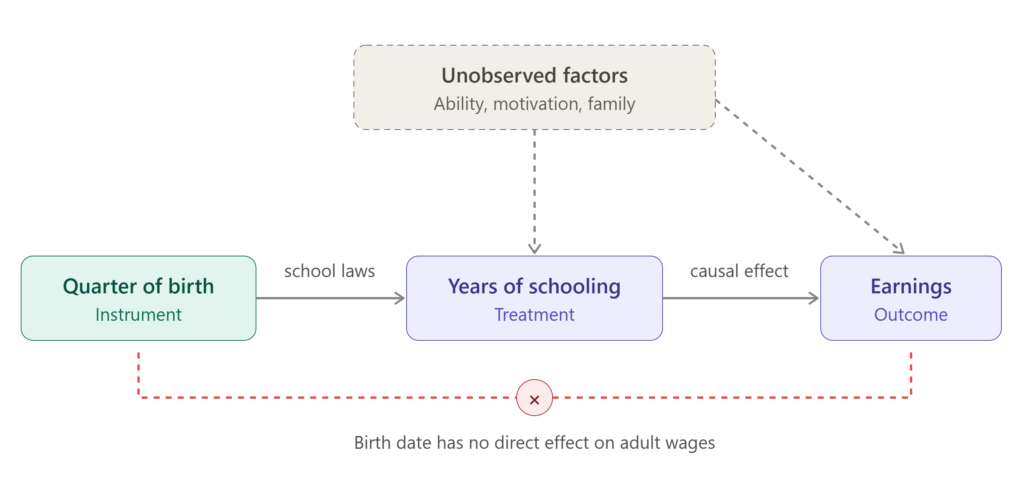
By using quarter of birth as an instrument, they were able to estimate the causal effect of education on income, effectively stripping away the bias of “natural ability.”
The Mechanism: How It Works (Two-Stage Least Squares)
You don’t need to do the math by hand, but understanding the logic helps. IV is typically executed via Two-Stage Least Squares (2SLS) :
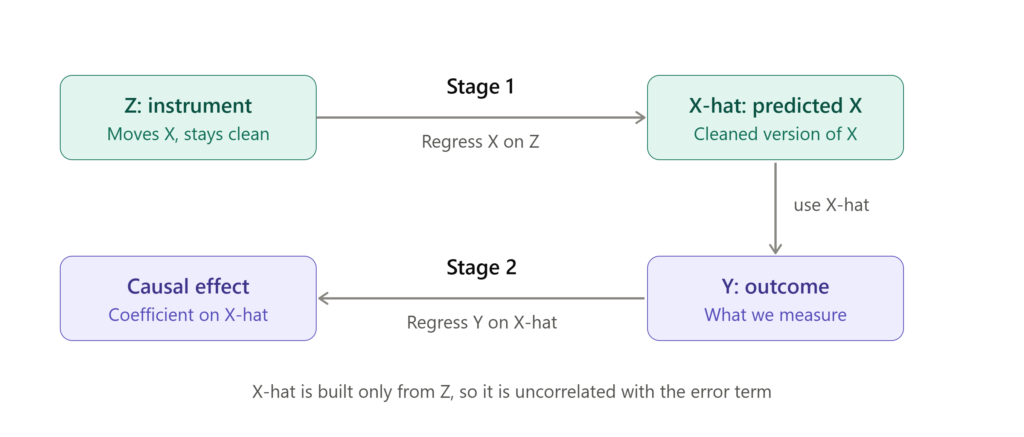
- Stage 1: Regress X on Z. This predicts the values of X based only on the instrument. We get a “cleaned” version of X (let’s call it X-hat) that is free from the endogeneity bias.
- Stage 2: Regress Y on X-hat. Because X-hat is not correlated with the error term, the resulting coefficient is a true causal estimate.
When Should You Use IV?
Instrumental Variables are not a silver bullet. They are used when:
- You have observational data (no randomized control trials).
- You suspect endogeneity (omitted variables or reverse causality).
- You have found a valid instrument (which is harder than it sounds).
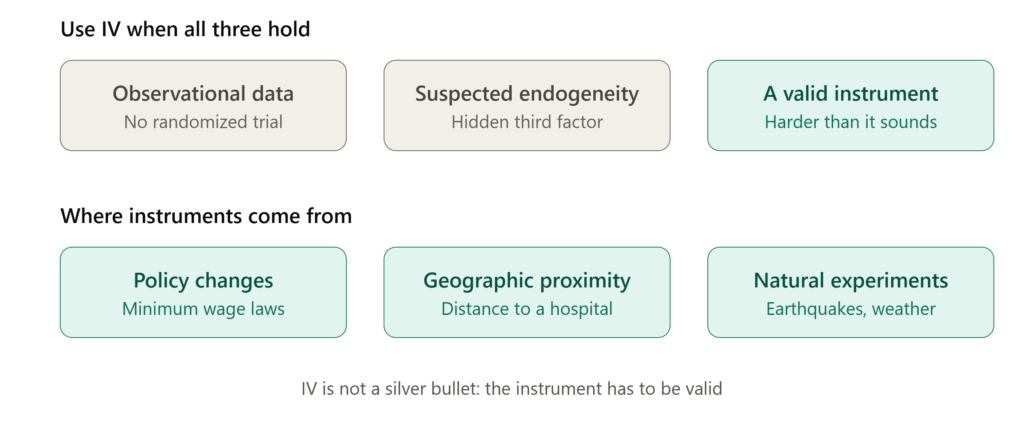
Common sources for instruments:
- Policy changes: Changes in laws (e.g., minimum wage laws).
- Geographic proximity: “Distance to a facility” (e.g., distance to a hospital as an instrument for healthcare access).
- Natural experiments: Random events (e.g., earthquakes, weather).
The Catch: The Weak Instrument Problem
The biggest danger with IV is the Weak Instrument. If your instrument (Z) is only weakly correlated with your variable of interest (X), the IV estimates can be worse than the biased OLS estimates.
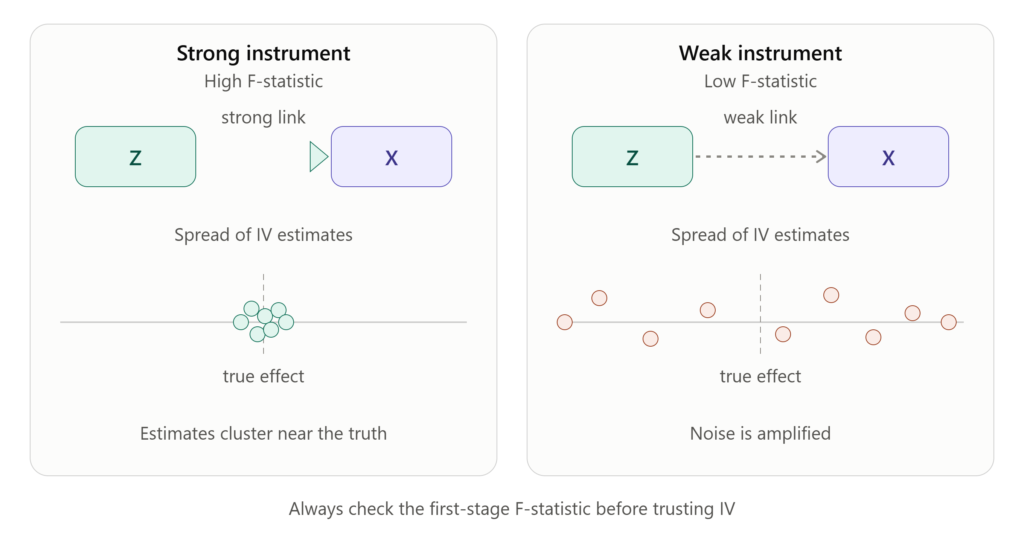
If you use a weak instrument, the statistical “noise” gets amplified, and you might end up with nonsensical results. Researchers always run diagnostic tests (like the F-statistic) to ensure the instrument is strong enough.
Conclusion
Endogeneity is the nemesis of causal inference. It lurks in the shadows of observational data, waiting to trick analysts into making false claims.
Instrumental Variables offer a clever, rigorous way to bypass this trap. By finding a variable that acts as a “random nudge” to the treatment, we can simulate the conditions of a randomized experiment.
While finding a valid instrument is difficult and requires deep subject-matter expertise, mastering IV is essential for anyone who wants to move beyond mere correlation and make credible causal claims.
Next time you see a messy dataset, don’t just run a regression—ask yourself: “What is my instrument?”