
Every expert was once a beginner. But in the fast-moving world of data analysis, the path from “What is a spreadsheet?” to “I just built a predictive model” can feel less like a roadmap and more like a maze. With countless tools, languages, and certifications competing for your attention, it’s easy to get lost, overwhelmed, or stuck in tutorial purgatory.
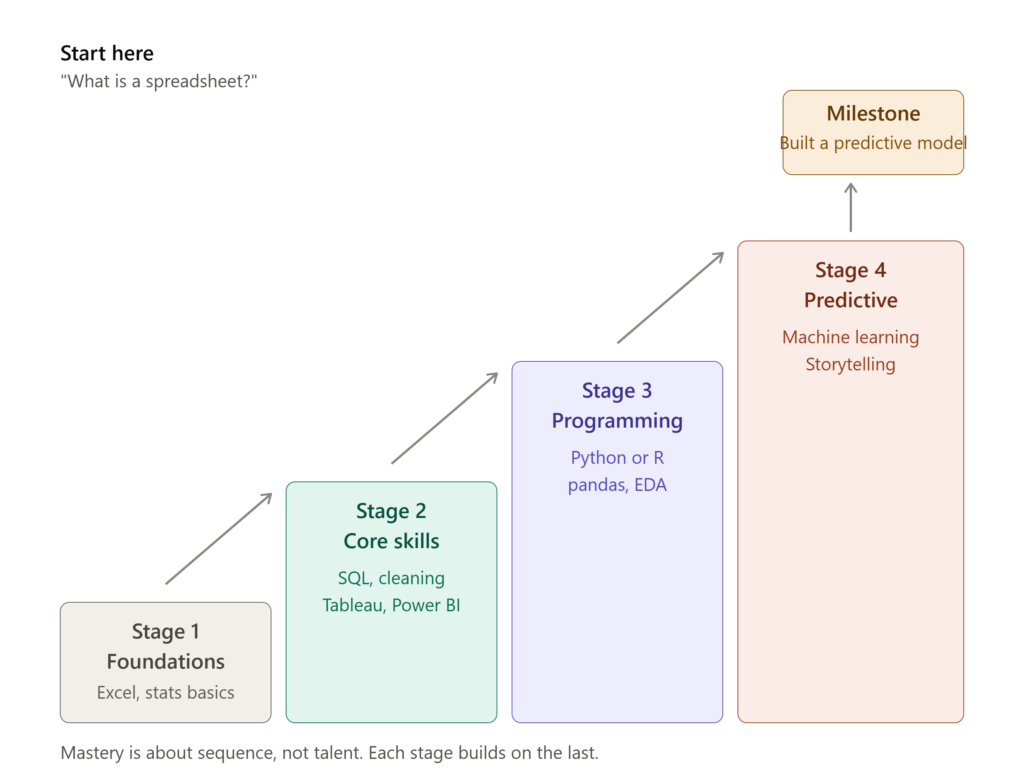
The good news? Mastery isn’t about talent—it’s about sequence. Like learning a language or an instrument, data analysis has a natural progression. Skip the fundamentals and you’ll struggle later; follow the right order and each stage builds on the last.
This roadmap breaks the journey into four clear stages, with the skills, tools, and milestones you need at each level. Wherever you are, find your stage—and start climbing.
Stage 1: The Foundation (Beginner)
Timeline: 1–3 months
Goal: Build comfort with numbers, logic, and basic tools.
Before touching Python or machine learning, you need to master the fundamentals. This stage is about building intuition—learning to “think in data.”
Core Skills to Develop:
- Spreadsheet proficiency — Excel or Google Sheets. Master formulas, pivot tables, VLOOKUP/XLOOKUP, and basic charts. This is still the most-used analytics tool in the business world.
- Descriptive statistics — Mean, median, mode, standard deviation, distributions. Understand what these tell you (and what they hide).
- Basic data cleaning — Removing duplicates, handling missing values, standardizing formats.
- Data visualization basics — Choosing the right chart for the right question.
Recommended Tools:
Excel / Google Sheets, a beginner statistics course (Khan Academy or Coursera).
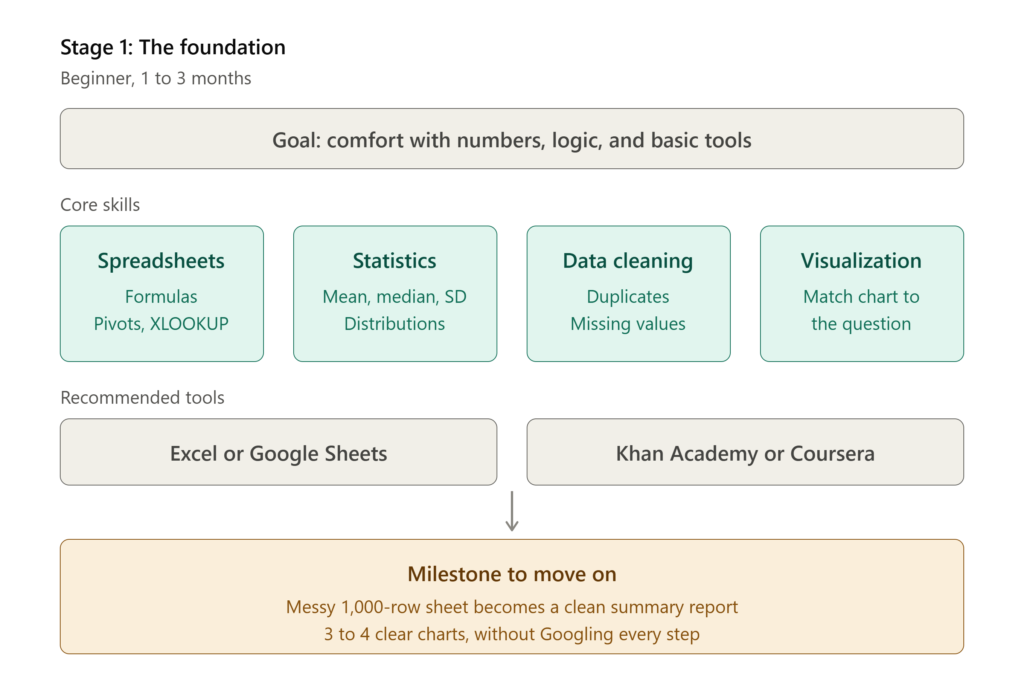
Milestone to Move On:
You can take a messy, 1,000-row spreadsheet and turn it into a clean, summarized report with 3–4 clear charts—without Googling every step.
Stage 2: The Toolkit (Intermediate)
Timeline: 3–9 months
Goal: Graduate from spreadsheets to code and real datasets.
This is where most people stall—and where the real leverage lives. Learning to code transforms you from someone who uses tools into someone who builds them.
Core Skills to Develop:
- SQL — The single most important skill in data analysis. Learn
SELECT,JOIN,GROUP BY, subqueries, and window functions. You will use SQL every single day. - Python (or R) — Start with Python. Focus on
pandasfor data manipulation andmatplotlib/seabornfor visualization. Don’t rush into machine learning yet. - Version control — Basic Git and GitHub. Even solo analysts need to track their work.
- Exploratory Data Analysis (EDA) — The structured process of profiling, cleaning, and interrogating a dataset before modeling.
Recommended Tools:
PostgreSQL or SQLite for practice, Jupyter Notebooks, Kaggle datasets.
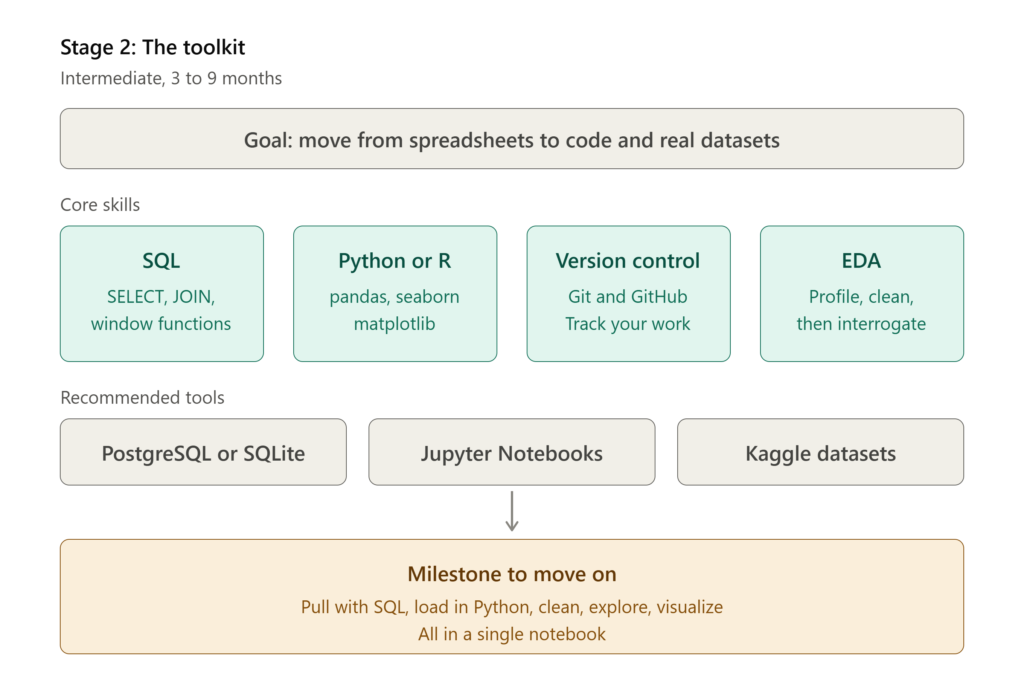
Milestone to Move On:
You can pull data from a database with SQL, load it into Python, clean it, explore it, and produce a clear visual analysis—all in a single notebook.
Stage 3: The Practitioner (Advanced)
Timeline: 6–12 months
Goal: Work like a professional analyst—on real problems, with real stakeholders.
This stage is less about learning new syntax and more about applying what you know in structured, business-relevant ways.
Core Skills to Develop:
- Statistics & experimentation — Hypothesis testing, A/B testing, confidence intervals, regression. This is where analysis becomes decision-making.
- Business acumen — Understand the domain you’re analyzing: marketing funnels, financial metrics, product engagement. Data skills without context are worthless.
- Dashboards & BI tools — Tableau, Power BI, or Looker. Learn to build dashboards that answer questions, not just display numbers.
- Data storytelling — Structuring a narrative around your findings. The best analysis fails if no one understands or acts on it.
- Introduction to machine learning — Regression, classification, and clustering with
scikit-learn. Understand when ML is (and isn’t) the answer.
Recommended Tools:
Tableau / Power BI, scikit-learn, a portfolio of 3–5 end-to-end projects.
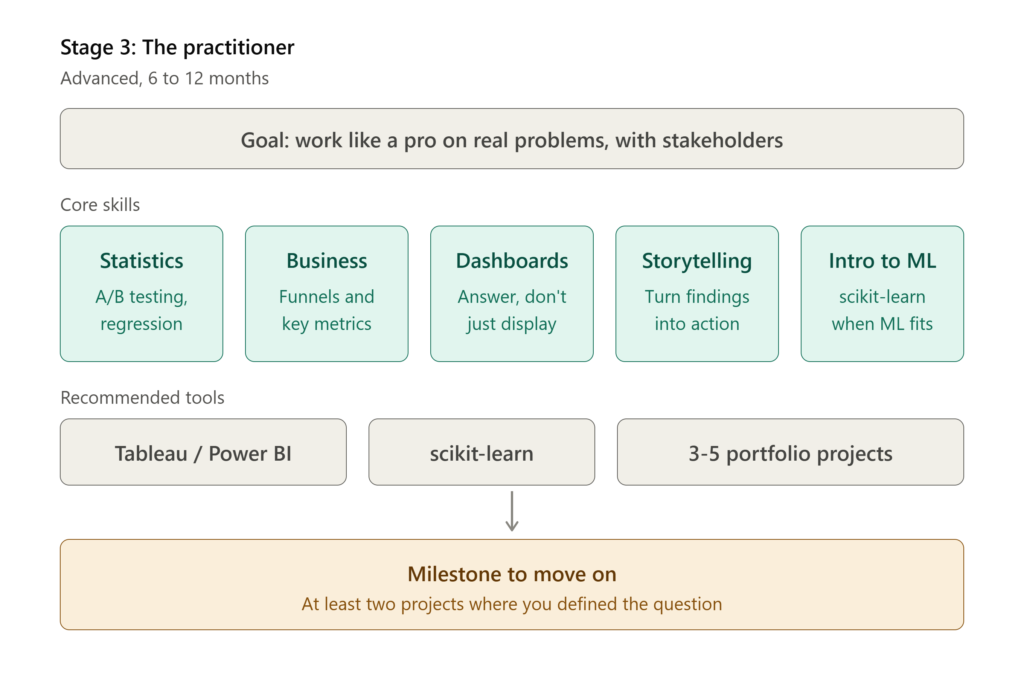
Milestone to Move On:
You’ve completed at least two projects where you defined the question, sourced the data, analyzed it, and presented actionable recommendations to a non-technical audience.
Stage 4: The Expert (Professional)
Timeline: Ongoing
Goal: Specialize, lead, and drive impact at scale.
“Expert” isn’t a finish line—it’s a shift in focus. At this level, you’re no longer just analyzing data; you’re designing systems, mentoring others, and connecting data to strategy.
Core Skills to Develop:
- Data engineering fundamentals — Pipelines, ETL/ELT, cloud warehouses (Snowflake, BigQuery), and orchestration. Understanding how data gets to you makes you 10x more effective.
- Advanced modeling — Deeper ML, forecasting, and causal inference—knowing the difference between correlation and causation at a rigorous level.
- Specialization — Pick a lane: product analytics, marketing analytics, financial analytics, data science, or analytics engineering. Depth beats breadth at this stage.
- Communication & influence — Presenting to executives, writing crisp memos, and framing analysis in terms of business impact.
- Mentorship & process — Code review, documentation, and helping others level up.
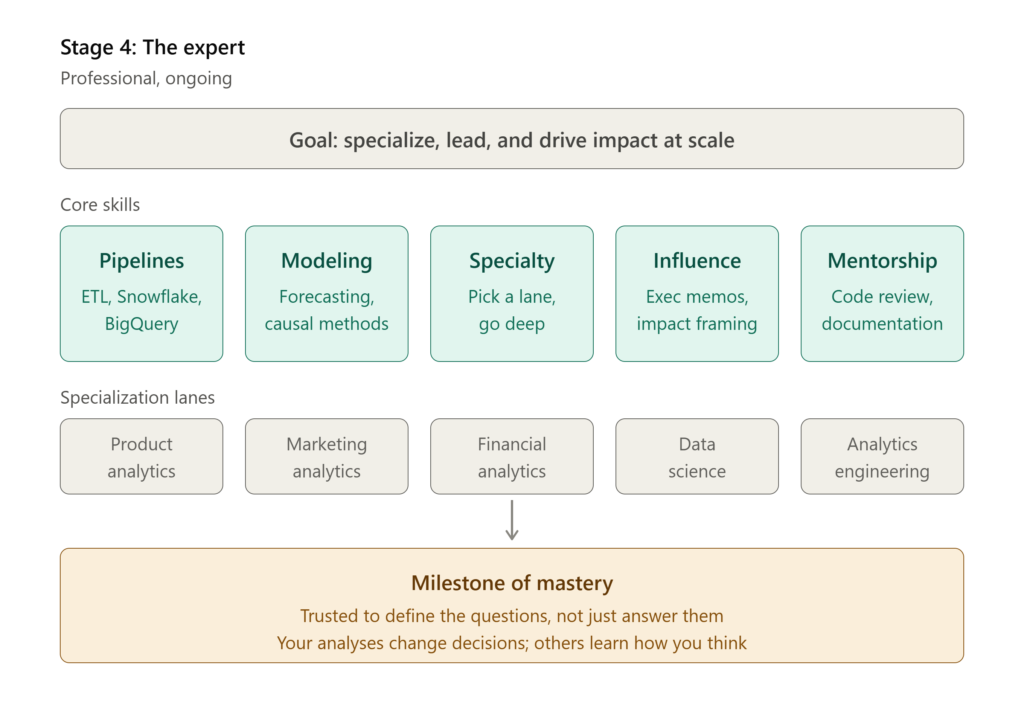
Milestone of Mastery:
You’re trusted to define the questions, not just answer them. Your analyses change decisions, and others come to you to learn how you think.
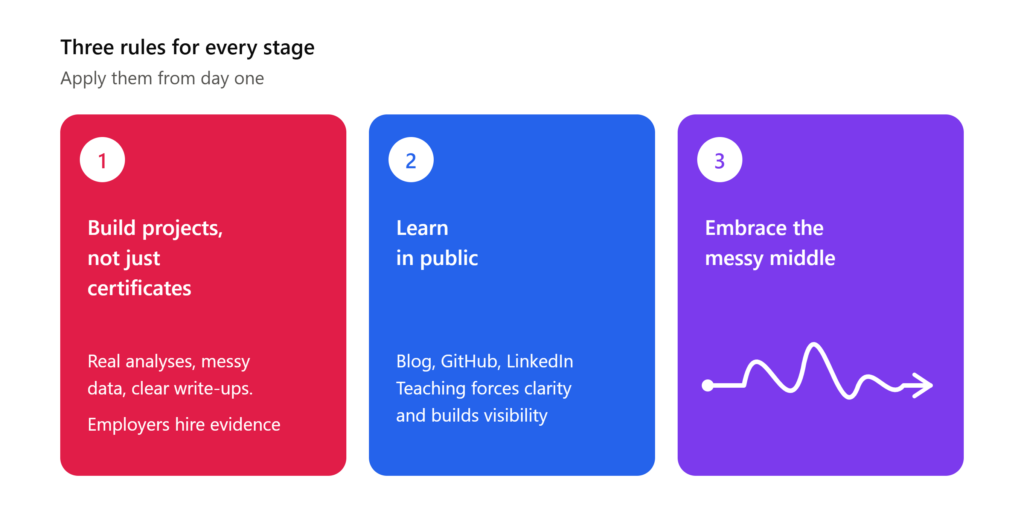
Three Rules That Apply at Every Stage
1. Build projects, not just certificates.
A portfolio of real analyses—messy data, real questions, clear write-ups—beats a stack of certificates every time. Employers hire evidence, not enrollment.
2. Learn in public.
Publish your work: a blog, a GitHub repo, a LinkedIn post. Explaining what you learned forces clarity and builds visibility. (This very blog is an example.)
3. Embrace the “messy middle.”
Real data is dirty, real questions are vague, and real stakeholders change their minds. The experts aren’t the ones who avoid mess—they’re the ones who’ve gotten comfortable in it.
The Bottom Line
Mastering data analysis isn’t about racing to the most advanced tool. It’s about building a layered foundation: fundamentals first, then tools, then application, then scale. Each stage makes the next one easier—and skipping stages only makes them harder later.
So find your stage, set your milestone, and start building. The path from beginner to expert isn’t a leap; it’s a staircase. And you’re already on it.